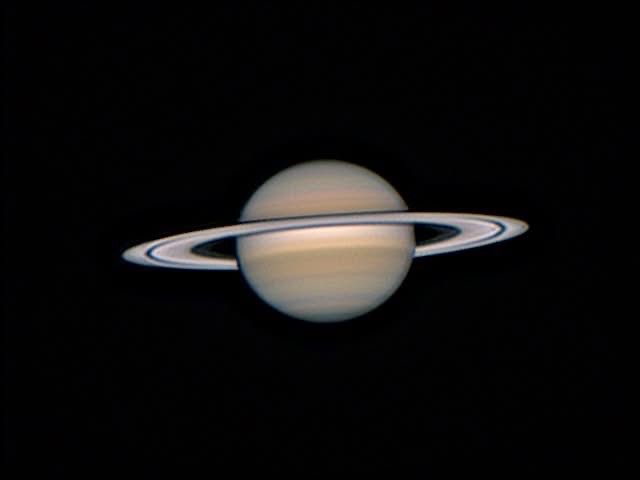
PiNox is the astronomy application I am developing within EIP, my embedded imaging platform. This Saturn session was an opportunity to use it with the HQ camera mounted on my telescope: help adjusting the atmospheric dispersion corrector (ADC), automatic framing and RAW recording. The measurements below describe the setup and acquisitions from this session.
The setup: Mewlon 250, Powermate and HQ camera
The camera receives the image formed by the telescope, without a lens or eyepiece. Between them, a Tele Vue Powermate 2× enlarges the image and an ADC corrects the colour dispersion introduced by the atmosphere.
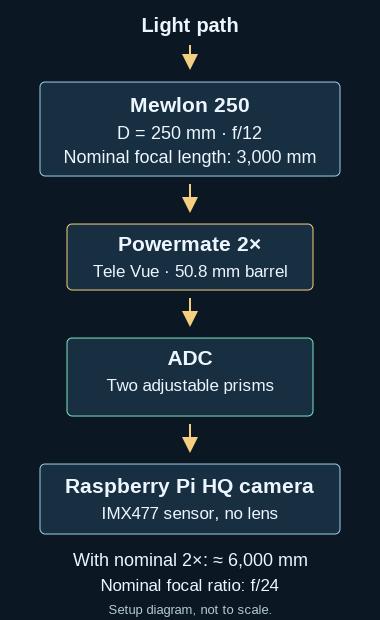
The Mewlon 250 has a 250 mm aperture and a nominal focal length of 3,000 mm, giving a focal ratio of 12. With the Powermate, the system nominally reaches a 6,000 mm focal length at f/24. This model maintains nearly constant magnification as the sensor distance changes.
The HQ camera's IMX477 sensor has photosites measuring 1.55 µm. The 2028 × 1520 mode used here bins pixels 2 × 2, giving an effective pixel pitch of 3.10 µm. At a 6,000 mm focal length, the nominal image scale is therefore:
I checked this order of magnitude on the final image, which was not resized. Saturn's globe measures approximately 179 pixels at the equator, for an apparent diameter of 19.659″ according to JPL Horizons at the time of the session. The ratio gives approximately 0.11″ per pixel, consistent with the setup. Measuring the globe's edge remains approximate; this value describes image scale, rather than actual resolution.
Adjusting the ADC with PiNox
The atmosphere does not refract all colours in the same way. This can produce an offset between the red, green and blue layers, more pronounced towards the horizon. The ADC uses two adjustable prisms to introduce opposite dispersion. Its orientation must account for the horizon, which is not necessarily horizontal on screen.
PiNox helps me adjust it by estimating the planet's centre in each colour directly from the sensor's Bayer colour filter array. Green is the reference; two markers show the red and blue offsets. Measurements are averaged over one second to make the trend easier to read despite atmospheric turbulence.
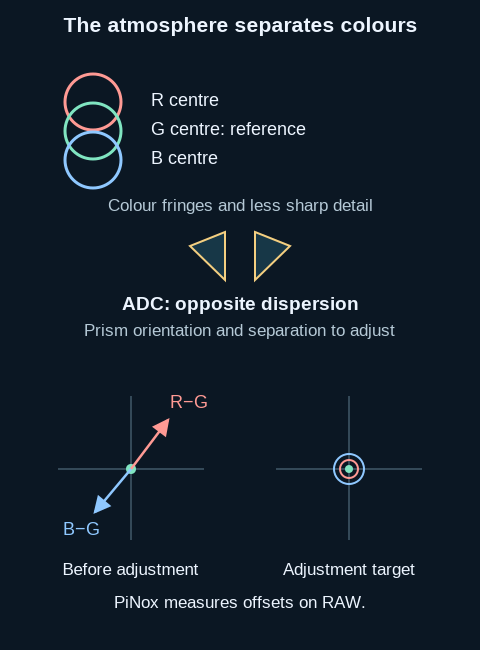
In practice, I keep the image unsaturated, let the markers settle, then gradually adjust the prisms. Digital colour alignment in the preview must be disabled to assess the fringes on screen as well. The tool is an adjustment aid: turbulence, noise and Saturn's structures affect the measured centres.
A small window that follows Saturn
PiNox records a 640 × 480 pixel window within the 2028 × 1520 source image. This window moves to follow the planet's drift. I can therefore keep tight framing without constantly readjusting it with the mouse.
Adjusting the ADC prisms can also cause a shift of the entire image on the sensor. I use the available field to leave Saturn at this new position, rather than readjusting collimation for this shift alone. Automatic tracking moves the window around the planet; it makes framing easier without replacing good optical alignment.
This tracking adjusts framing, rather than the mount's motors. It reduces the recorded volume, but does not speed up sensor readout. Saturn must remain within the available field.
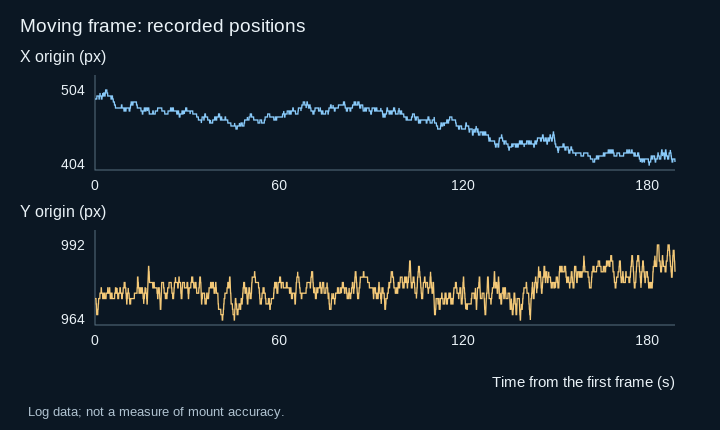
capture_20261015T202412Z.avi): 3,000 window-origin positions, in pixels of the 2028 × 1520 source mode. These curves describe the reframing performed by PiNox.Preview and RAW recording
In the browser
The colour preview is used for focusing, adjusting the rendering and monitoring acquisition.
On local storage
Bayer frames are recorded independently of the preview, without lossy compression.
For this session, the videos are AVI files in 8-bit RAW (RAW8), with a BGGR mosaic (blue-green / green-red): each recorded pixel occupies one byte. Colours are reconstructed during processing. Files are written to the drive connected to the Raspberry Pi; the network carries only the preview and commands.
By default, rendering settings affect only the preview. The “Apply to recording” option also allows digital gain, gamma, levels, saturation and white balance to be applied directly to the Bayer mosaic, without demosaicing. These settings are chosen before the series and remain fixed during recording to keep frames consistent for processing. The colour/luminance toggle, sharpening and preview stacking remain display-only and can be changed.
A mosaic processed in this way retains its Bayer structure, but its values have changed. Measurements of the sensor signal require unprocessed RAW.
For this image, the settings applied to recorded values were: subtraction of black level 16 in RAW8, digital gain ×2 and balance R=3, G=1, B=2. Gamma and saturation remained neutral.
The eight videos in numbers
| Parameter | Value |
|---|---|
| Source image | 2028 × 1520 pixels |
| Recorded window | 640 × 480 pixels |
| Format | AVI RAW8, Bayer BGGR |
| Exposure time | 60 ms |
| Frame rate | Approximately 15.88 frames/s |
| Contents of each video | 3,000 frames, approximately 3 min 09 s |
| Total for the eight videos | 24,000 frames, approximately 25 min 12 s excluding pauses |
| Selection in AstroSurface | 50% of frames, approximately 12,000 |
| Total size | Approximately 7.37 GB |
| Required write rate | Approximately 4.88 MB/s |
| Frames dropped during acquisition | 0 across these eight videos |
I chose exposures of 60 ms to collect enough light. This exposure time sets a theoretical ceiling of approximately 16.7 frames/s; the recorded frame rate is 15.88 frames/s. Sixteen frames per second therefore reflects the conditions of this acquisition, rather than an intrinsic PiNox limit.
Throughput is straightforward to calculate: 640 × 480 pixels × 1 byte × 15.88 frames/s, or approximately 4.88 MB/s. At the same frame rate, recording the full source image would require nearly 49 MB/s. Framing therefore reduces the volume to write by approximately 90%.
The eight files each contain all 3,000 frames, with no losses reported during acquisition. This result applies to the configuration used: a larger image or higher frame rate would demand more from storage.
From processing to the final image
In AstroSurface, I selected the sharpest 50% of frames from the eight videos, approximately 12,000 out of the 24,000 recorded. I then aligned and stacked them, before bringing out the detail.
Now I need to get back under the sky. The hundreds of hours of development are quickly forgotten when framing follows the planet, frames are recorded and I can concentrate on Saturn. The little HQ still has plenty of sky ahead.
Continue reading
The story of the session
Saturn from my balcony, with PiNox and the HQ camera · Discovery version.